
Choosing a carburetor supplier is not simply a matter of comparing prices. A carburetor must deliver the correct air–fuel mixture across different engine speeds, temperatures and operating conditions. Small differences in calibration, machining or component quality can lead to hard starting, unstable idling, poor acceleration, excessive fuel consumption or premature failure.
For importers, distributors and aftermarket brands, the right supplier should provide consistent products, accurate application data and dependable support. The following seven checks can help you evaluate a potential carburetor manufacturer.
1. Verify the Exact Application
Two carburetors may look almost identical while using different internal calibrations, mounting dimensions or control systems. Selecting a product from appearance alone can easily result in an incorrect match.
Before requesting a quotation, collect as much application information as possible:
- Vehicle or equipment make and model
- Production year
- Engine model and displacement
- Original equipment or replacement part number
- Manual or automatic choke
- Mounting-hole dimensions
- Throttle linkage configuration
- Fuel inlet position
- Clear photographs of the original unit
For older vehicles, agricultural machinery and industrial engines, the engine number is often more reliable than the vehicle model alone. A qualified supplier should review these details before confirming compatibility. If the available information is incomplete, requesting a sample for installation testing is safer than placing a large initial order.
2. Check Machining and Dimensional Control
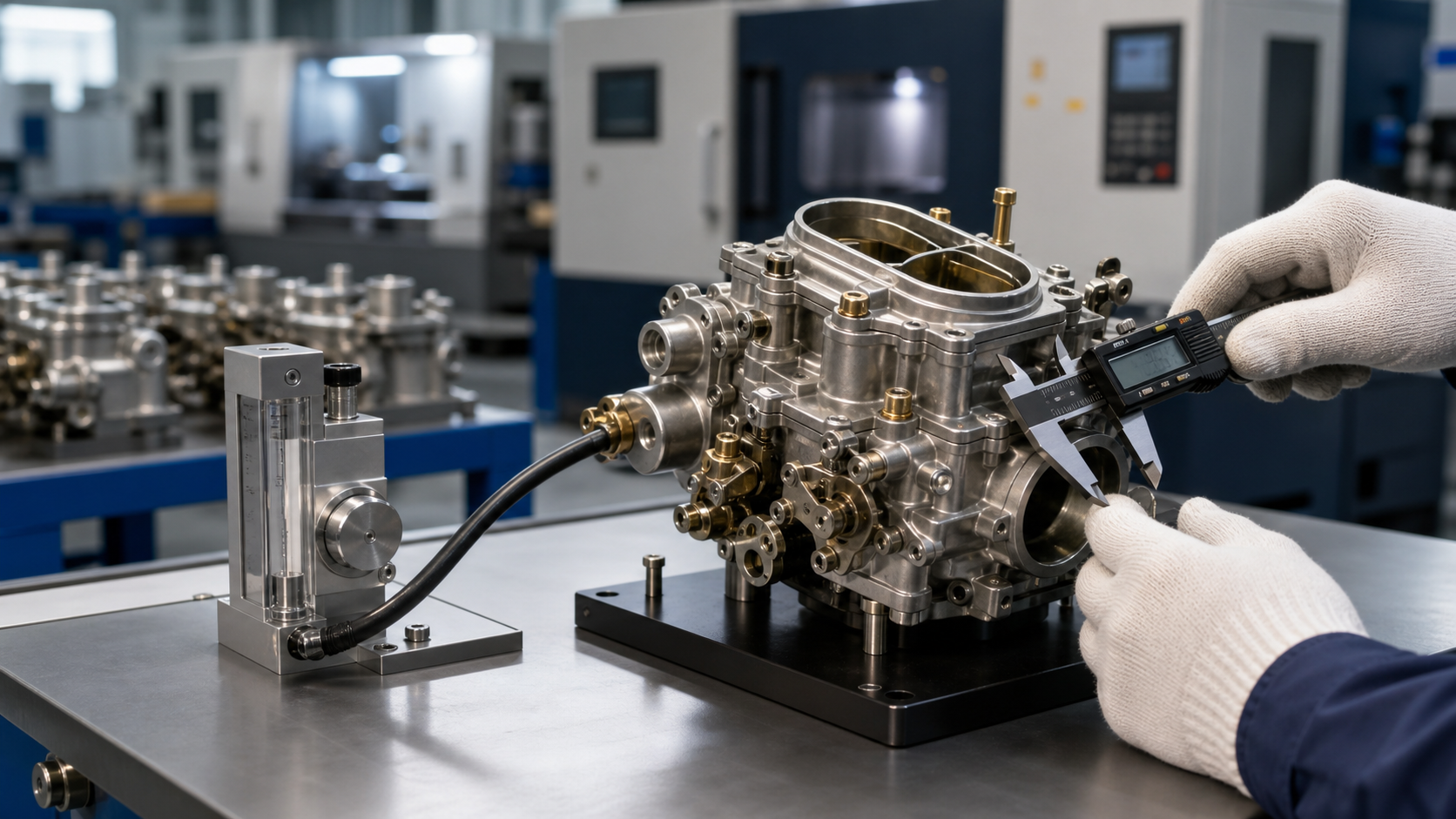
The carburetor body contains precision passages that control fuel and air flow. Bore dimensions, mounting surfaces, throttle-shaft alignment and threaded connections must remain consistent from one production batch to another.
Ask the manufacturer how it controls main bore and venturi dimensions, flange flatness, throttle-shaft clearance, jet and passage dimensions, thread accuracy and critical assembly tolerances.
Excessive throttle-shaft clearance can create an air leak and unstable idle. An uneven mounting surface may cause sealing problems. Poorly controlled jets or passages can change the fuel mixture even when the external appearance is correct. Reliable suppliers should use documented inspection procedures instead of relying only on visual checks.
3. Review Fuel-System Component Quality
The quality of internal components has a direct effect on carburetor performance and service life. Important components include the float, needle valve, jets, accelerator-pump diaphragm, gaskets, seals, springs and adjustment screws.
- The float should move freely without interference.
- The needle valve should close consistently.
- Rubber components should be suitable for modern fuels.
- Gaskets should fit the sealing surfaces correctly.
- Jets and adjustment screws should be cleanly machined.
- Linkages should return smoothly without binding.
- Metal parts should have appropriate corrosion protection.
Low-cost internal components may perform acceptably during a short inspection but fail after repeated exposure to fuel, heat and vibration. Importers should therefore evaluate both initial performance and durability.
4. Ask About Flow and Functional Testing
A visual inspection cannot confirm whether a carburetor is correctly calibrated. Functional testing is essential for detecting problems such as incorrect fuel delivery, leakage or inconsistent airflow.
- Fuel leakage testing
- Float-level inspection
- Throttle and choke operation checks
- Accelerator-pump testing
- Airflow and fuel-flow measurement
- Idle and progression-circuit verification
- Final visual and packaging inspection
The testing method should use defined conditions and acceptance standards. For repeat orders, consistent test records can help identify production variation before products reach the market.
5. Confirm Batch Consistency and Traceability
A good sample does not always guarantee stable mass production. Ask how the manufacturer controls different production lots and whether finished products can be traced to their inspection or assembly records.
- Production batch numbers
- Incoming-material inspection records
- In-process and final test records
- Sample retention
- Product labels or date codes
- Documented handling of nonconforming products
Traceability becomes especially important when a distributor sells products under its own brand. If a problem occurs, the supplier should be able to identify the affected batch and respond with evidence rather than assumptions.
6. Evaluate Packaging and Product Identification
Carburetors contain small linkages, fittings and adjustment components that can be damaged during transportation. Packaging must protect the product from impact, moisture and contamination.
- Inner protection around linkages and fittings
- Dust and moisture protection
- Carton strength
- Product labels and part-number accuracy
- Barcode requirements
- Installation accessories
- Private-label packaging options
Clear identification also reduces warehouse errors. The product, inner box, master carton and packing list should use consistent part numbers. For a wide product range, accurate labeling is just as important as product quality.
7. Assess Technical and After-Sales Support
Carburetor applications can be complicated, particularly for older vehicles or products sold in several markets under different part numbers. A supplier should be able to help investigate application questions, sample verification, technical drawings, installation feedback, warranty claims, packaging customization and product-development requests.
Fast communication is useful, but technically accurate communication is more important. A dependable supplier should be willing to verify uncertain information instead of confirming every application without evidence.
Start With a Controlled Sample Order
For a new supplier or unfamiliar application, begin with samples or a controlled trial order. Record the engine information, test conditions and installation results for each product. Evaluate cold and warm starting, idle stability, throttle response, acceleration, fuel leakage, fitment, linkage movement and performance after extended use.
Once the samples pass inspection, establish an approved specification before increasing the order quantity. This creates a clear reference for future production and quality discussions.
A Carburetor Supplier Should Provide More Than a Product
The right supplier combines application knowledge, controlled manufacturing, functional testing, traceability and responsive support. These capabilities reduce incorrect purchases, customer complaints and avoidable warranty costs.
Lantech has focused on carburetors and related components since 2008. Our product range covers automotive, motorcycle, ATV/UTV, tractor, forklift, marine and small-engine applications.
Need help identifying a carburetor? Send us the OE number, engine model and clear photographs of the original unit. Our team will review the information and help you find the appropriate product or arrange a sample for verification.
